


Pulsar Watch Repair – Fix Broken Pulsar
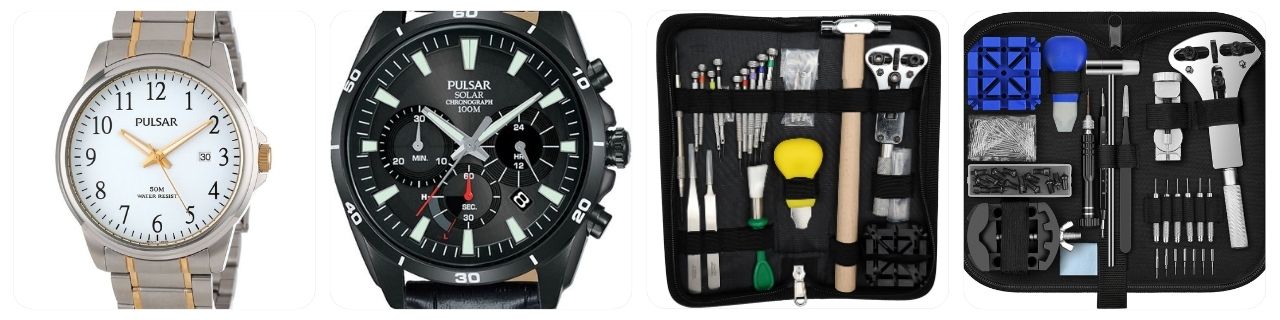
Got a Pulsar that suddenly stopped ticking, refuses to reset, has a cloudy crystal, or has been sitting forgotten in a drawer for years? Plenty of Pulsar problems are repairable, especially the brand’s quartz and chronograph models. This guide covers common Pulsar faults, practical fixes, estimated repair prices, service options, and what to check before buying a broken Pulsar as a restoration project.
What are you looking for?
- Pulsar Watch Fix Common Issues
- Pulsar Watch Repair Cost
- Pulsar Service Center Near Me Finder
- Buy Broken Pulsar Watch
- Broken Pulsar Watch FAQ
Broken Pulsar Watch? Fix Common Pulsar Watch Problems and Issues
Pulsar quartz watch has completely stopped: A dead battery is easily one of the first things to suspect with the many battery-powered Pulsar models. Check the caliber or case number before buying a cell because different Pulsar movements use different batteries. A Pulsar watch battery replacement search can help you compare common batteries and basic replacement tools.
Pulsar watch still does not run after a new battery: If a fresh, correctly installed battery does nothing, don’t keep swapping cells. Older Pulsar quartz movements can suffer from dirty battery contacts, leaked batteries, damaged coils, seized gear trains, or failed electronic modules. Have the movement tested before buying more parts, especially if you see green, white, or rusty corrosion around the battery compartment.
Pulsar chronograph hands will not reset to zero: Many Pulsar analog chronographs use Seiko-family quartz movements that allow the chronograph hands to be recalibrated after a battery change. The exact button sequence depends on the caliber, so find the caliber number on the caseback and follow its instructions. If recalibration fails, the pusher, stepper motor, or chronograph movement may need repair.
Pulsar watch is losing or gaining a lot of time: A quartz Pulsar should normally keep fairly consistent time, so a major sudden error deserves attention. Start with a fresh battery if the existing cell is old. Strong magnetism, moisture, impact damage, dirty movement components, or an aging quartz module can also cause trouble. Severe or irregular errors usually justify professional movement testing.
Pulsar crown is loose, broken, or missing: Don’t continue wearing a Pulsar with a missing crown because moisture and dirt can enter through the exposed crown tube. Replacement involves matching the crown and stem to the specific case and movement. Generic watch crown and stem replacement kits can be useful for practice, but model-specific Pulsar parts are preferable.

Watch Link Removal Kit, BYNIIUR Watch Repair Kit, Watch Case Opener Spring Bar Tools, Watch Battery Replacement Tool Kit, Watch Band Link Pin Tool Set with Carrying Case and Instruction Manual

JOREST Watch Repair Kit for Battery Replacement & Link Removal, Resizing &Opener, Watch Repair and Cleaning Screwdriver Set, Wrench Back Remover, Spring Bar Tool

Singcci Watch Repair Kit, 151 PCS Professional Watch Battery Replacement Tool Kit, Watch Strap Bracelet Removal Tool with Carrying Case and Instructions
Pulsar watch has condensation under the crystal: Fogging means moisture has gotten past the seals. Stop using the crown and pushers and keep the watch away from additional water. Simply drying the outside is not enough. The movement should be inspected for corrosion, while the caseback gasket, crystal seal, crown, and pushers should be checked before the watch is pressure-tested again.
Pulsar solar watch will not charge or stay running: Some later Pulsar watches use solar-powered movements rather than ordinary disposable batteries. Give the dial extended exposure to suitable light and check whether the watch begins charging. If it still dies quickly after a proper charge, the rechargeable cell may have deteriorated and require replacement rather than an ordinary silver-oxide battery.
Pulsar digital or Ana-Digi display is fading or blank: Vintage and later digital Pulsar models can develop weak LCD displays, failing illumination, contact problems, or electronic module faults. Start with the correct fresh battery. If only part of the display appears, the LCD contacts or module may need attention. Vintage Pulsar digital electronics can require specialist repair because replacement modules are increasingly difficult to find.
Pulsar bracelet, clasp, or spring bar is broken: Older Pulsar bracelets frequently develop loose pins, worn clasps, stretched links, or missing spring bars. A simple spring-bar issue is inexpensive, while a discontinued integrated bracelet can be much harder to replace. Measure the lug width carefully before ordering a Pulsar replacement watch band or compatible bracelet.
Vintage Pulsar LED watch does not light up: Early Pulsar LED watches are very different from later Seiko-produced Pulsar quartz models. A non-working 1970s Time Computer-style Pulsar can have battery-contact, reed-switch, LED display, circuit, or module problems. Avoid experimenting with random batteries or voltage sources because surviving electronic modules are collectible and difficult to replace. Specialist vintage LED servicing is usually the better route.
How much does a Pulsar watch repair and maintenance cost?
Pulsar repair prices vary quite a bit because the brand covers everything from straightforward quartz watches to chronographs, solar models, digital watches, and collectible early LED pieces. For ordinary Seiko-era Pulsar watches, movement replacement can sometimes make more financial sense than rebuilding a badly damaged quartz caliber. Vintage LED Pulsars are a completely different story and can become considerably more expensive.
- Pulsar battery replacement: Around $20 – $60 for a standard quartz battery replacement, case inspection, and basic function check.
- Battery replacement with pressure test: Around $40 – $90 when gasket inspection, resealing, and water-resistance testing are included with the battery service.
- Pulsar quartz movement service: Around $100 – $200 for movement diagnosis, repair or replacement, adjustment, and functional testing.
- Pulsar chronograph repair: Around $125 – $300 depending on caliber, pusher condition, movement availability, and the extent of the chronograph fault.
- Pulsar solar movement repair: Around $100 – $250 for rechargeable-cell replacement, movement diagnosis, charging tests, and related components.
- Pulsar crystal replacement: Around $60 – $180 depending on crystal material, dimensions, shape, gasket availability, and case construction.
- Pulsar crown and stem replacement: Around $60 – $150 depending on the watch reference, crown availability, stem work, seals, and testing.
- Pulsar bracelet or clasp repair: Around $30 – $150 for pins, spring bars, clasp repairs, sizing, or a compatible replacement bracelet.
- Water-damaged Pulsar repair: Around $150 – $400+ if moisture has damaged the movement, dial, hands, crown, seals, or electronic components.
- Vintage Pulsar LED restoration: Around $250 – $1,000+ when rare electronic modules, display work, case restoration, or specialist troubleshooting is required.
The United States SEIKO Service Center currently lists roughly $100 – $135 for servicing analog battery or rechargeable-battery-powered movements and $113 for non-diver analog/digital combination movements, although the actual amount for a Pulsar depends on its caliber and condition. Older discontinued calibers, unavailable cosmetic pieces, extensive corrosion, and vintage LED components can push the total much higher.
Watch Link Removal Kit, BYNIIUR Watch Repair Kit, Watch Case Opener Spring Bar Tools, Watch Battery Replacement Tool Kit, Watch Band Link Pin Tool Set with Carrying Case and Instruction Manual
JOREST Watch Repair Kit for Battery Replacement & Link Removal, Resizing &Opener, Watch Repair and Cleaning Screwdriver Set, Wrench Back Remover, Spring Bar Tool
Singcci Watch Repair Kit, 151 PCS Professional Watch Battery Replacement Tool Kit, Watch Strap Bracelet Removal Tool with Carrying Case and Instructions
Pulsar Watch Repair & Service Center Near Me
Finding an official Pulsar repair facility can be a little confusing because Pulsar has historically been part of the Seiko watch family, and service arrangements vary depending on the country. In the United States, Pulsar repairs are currently handled through the official SEIKO Service Center rather than a standalone Pulsar-branded repair network.
If you have a relatively recent Pulsar, start by checking the warranty booklet, paperwork, original retailer information, and the country-specific support information supplied with the watch. Your caseback should contain a caliber and case number such as a combination of letters and numbers. Write this down before contacting a repair facility because it helps identify the movement and available replacement components.
For an older Pulsar, especially a discontinued quartz chronograph or digital model, ask whether the service center still has parts for your exact caliber before mailing the watch. A watch can be mechanically repairable while the original dial, crystal, bezel, bracelet, digital module, or other cosmetic component is no longer available.
Vintage 1970s Pulsar LED watches deserve extra care. These early electronic watches predate the more familiar later Pulsar range and use specialized electronic modules. A normal battery-and-watch-repair shop may not be equipped to repair the original LED circuitry, magnetic command switches, display modules, and battery system.
Before sending any Pulsar away, photograph the front, back, sides, crown, bracelet, clasp, and existing cosmetic damage. Write down the complete case and caliber numbers as well. Ask for a written estimate before authorizing expensive repairs and confirm whether declined estimates, return shipping, or replacement components create additional charges.
If your Pulsar only needs a battery, don’t overlook water resistance. Replacing the cell without checking the caseback gasket can leave an otherwise perfectly good watch vulnerable to moisture. This is especially important for sports and chronograph models that may originally have carried a meaningful water-resistance rating.
Broken Pulsar Watch For Sale
Thinking about buying a broken Pulsar watch as a DIY repair or restoration project? Below, you’ll find listings for Pulsar watches that may need servicing, replacement parts, or other repairs. Before purchasing, carefully review the item description, photos, seller feedback, return policy, and stated condition, and complete your own due diligence to make sure the watch is suitable for your repair skills and budget.
Broken Pulsar watches can actually make fun restoration projects because many conventional quartz models use movements from the broader Seiko family. Still, don’t assume every non-running Pulsar simply needs a battery. Sellers often use phrases like “untested,” “needs battery,” or “not currently working” when they genuinely have no idea whether the movement functions.
Look closely for battery leakage, missing crowns, cracked LCD panels, broken pushers, missing bracelet links, water staining on the dial, corrosion around the caseback, and badly scratched or cracked crystals. Those issues can quickly make an inexpensive project more costly.
The caliber and case number are particularly useful when shopping for a donor watch. Two Pulsars that look almost identical from the front can use different movements, crowns, pushers, crystals, and bracelets. Matching the full reference information greatly improves your chance of buying useful donor components.
Be especially cautious with collectible vintage Pulsar LED watches. Original cases and modules can have significant value even when non-running, but electronic repairs require specialized knowledge. Verify authenticity and completeness before paying collector prices for a watch advertised as a simple restoration project.
Broken Pulsar Watch Repair FAQ
Why did my Pulsar watch suddenly stop working?
A depleted battery is the obvious first suspect on a standard quartz Pulsar, but it is not the only possibility. Battery leakage, dirty contacts, a damaged coil, seized gears, moisture, or a failed electronic movement can produce the same symptom. Install the correct battery first, then have the movement tested if it remains dead.
Is an old Pulsar watch worth repairing?
It depends heavily on the model. An inexpensive conventional quartz Pulsar may not justify a very expensive restoration unless it has sentimental value. Older chronographs and unusual digital models can be more collectible, while original 1970s Pulsar LED watches are a separate collectible category where professional restoration can make considerably more sense.
Can I change a Pulsar watch battery myself?
Yes, many basic Pulsar quartz watches can be opened and fitted with a replacement battery using inexpensive watch tools. The bigger concern is damaging the caseback, battery contacts, coil, or gasket. If the watch needs to remain water resistant, professional replacement with gasket inspection and pressure testing is the safer approach.
Why does my Pulsar chronograph hand not return to 12 o’clock?
The chronograph hand may simply need electronic zero-position adjustment, especially after the battery has been replaced. The calibration procedure differs by Pulsar caliber. Check the movement or case number and locate the correct instructions rather than randomly pressing the buttons. A hand that cannot be recalibrated may indicate an internal movement problem.
Can a vintage Pulsar LED watch still be repaired?
Often yes, but these watches are much more specialized than ordinary Pulsar quartz models. Original LED displays, circuitry, battery contacts, magnetic switches, and electronic modules can fail after decades. Replacement parts are scarce, so valuable early Pulsar LED watches are best handled by a repairer who specifically works on vintage LED and electronic watches.
Related posts




Popular Articles
Recent Articles
- Pulsar Watch – Price List and Dealer Finder
- Pulsar Watch Parts & Diagram
- Pulsar Watch Repair – Fix Broken Pulsar
- Pulsar Watch Service Center & Dealer Near Me
- Pre-Owned Pulsar Watches: Trusted eBay Sellers
JOREST Watch Repair Kit for Battery Replacement & Link Removal, Resizing &Opener, Watch Repair and Cleaning Screwdriver Set, Wrench Back Remover, Spring Bar Tool
Watch Link Removal Kit, BYNIIUR Watch Repair Kit, Watch Case Opener Spring Bar Tools, Watch Battery Replacement Tool Kit, Watch Band Link Pin Tool Set with Carrying Case and Instruction Manual

EasyTime Watch Repair Kit 149IN1: Watch Link Removal & Battery Replacement | Complete Watch Repair Tools & Kits - Easy to Repair Your Watch with Back Case Opener, Spring Bar, Manual - An Ideal DIY Gift


